






The Legion Unvarnished
Literature and the Legion
By Christian Morisot
The Legion has its own literature. Like the epic poems of the Middle Ages, it has inspired the heroic and adventurous characters we know. Since its creation in 1831, literature about the Legion has traversed so many lands, won so many battles, inspired so many sacrifices, created so many legendary figures, and given refuge to so many human beings that it deserves to have its own stories, novelists, and poets.
Much has been written about "Camerone," which is on every legionnaire's priority list this month. It is also true that the sacrifice of these legionnaires, overwhelmed by a Mexican horde, is very moving to read, but many other less well-known and less celebrated events also took place, and historians find in them a sense of discovery and sincerity, a striking realism that often makes one feel as if they were there themselves…
It's like a firsthand account…
Thus, these stories and anecdotes are published in a much-appreciated simplicity of style. These works are essential witnesses, and for many of them, they do not stray too far from the reality of the events as they are revealed in their writings.
The place that the Legion occupies in the realm of literature must be recognized because it honors one of the finest expressions of the human spirit.
However, let us not be mistaken; despite the heroic narrative of the Battle of Camerone, we must not forget an inconvenient truth:
Indeed, the Mexican campaign was the salvation for the Legion that nearly led to its demise. In 1861, the 1st Foreign Regiment was dissolved and enlistments were suspended. It was then clear that the reduction of the Legion's numbers had begun, preceding its planned disappearance.
The Legion has its own literature. Like the epic poems of the Middle Ages, it has inspired the heroic and adventurous characters we know. Since its creation in 1831, literature about the Legion has traversed so many lands, won so many battles, inspired so many sacrifices, created so many legendary figures, and given refuge to so many human beings that it deserves to have its own stories, novelists, and poets.
Much has been written about "Camerone," which is on every legionnaire's priority list this month. It is also true that the sacrifice of these legionnaires, overwhelmed by a Mexican horde, is very moving to read, but many other less well-known and less celebrated events also took place, and historians find in them a sense of discovery and sincerity, a striking realism that often makes one feel as if they were there themselves…
It's like a firsthand account…
Thus, these stories and anecdotes are published in a much-appreciated simplicity of style. These works are essential witnesses, and for many of them, they do not stray too far from the reality of the events as they are revealed in their writings.
The place that the Legion occupies in the realm of literature must be recognized because it honors one of the finest expressions of the human spirit.
However, let us not be mistaken; despite the heroic narrative of the Battle of Camerone, we must not forget an inconvenient truth:
Indeed, the Mexican campaign was the salvation for the Legion that nearly led to its demise. In 1861, the 1st Foreign Regiment was dissolved and enlistments were suspended. It was then clear that the reduction of the Legion's numbers had begun, preceding its planned disappearance.
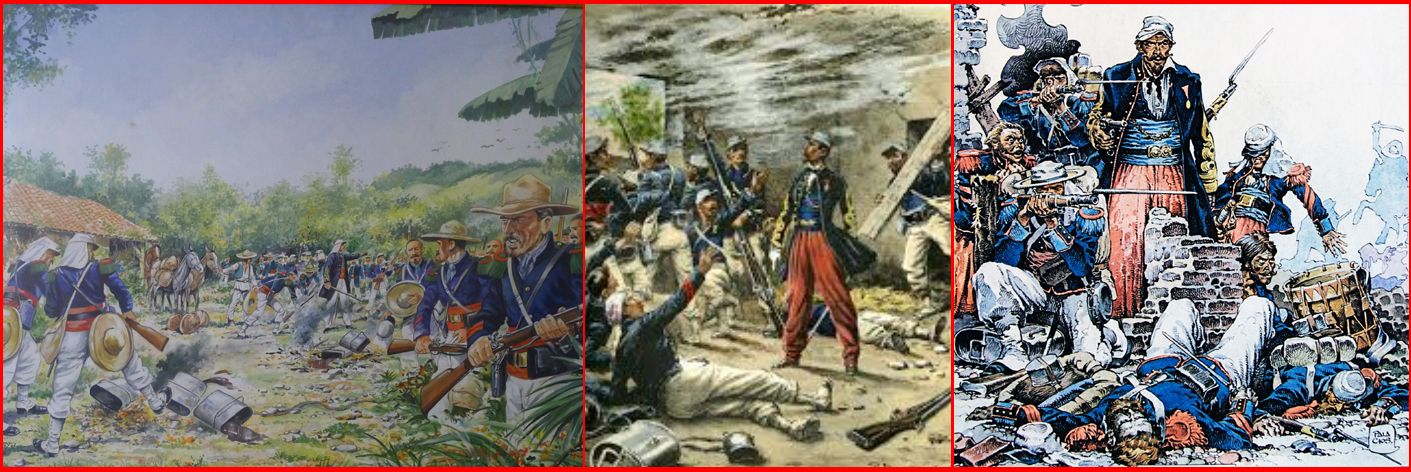
In 1864, precisely because of the Mexican campaign, enlistments resumed, as Emperor Napoleon III was experiencing great difficulty recruiting volunteers in France. Thus, the Convention of Miramar was signed on April 10, 1864 (one year after Camerone), stipulating: "The Legion will remain French as long as France is present in Mexico, and will then come under the command of the Mexican government if Maximilian takes power."
After Spain, the Legion's transformation into a commodity became clear… It was then obvious that the numerous expressions of gratitude were nothing but hypocritical empty talk… For the legionnaires, despite their initial enthusiasm, their first glimpses of Mexico triggered dark forebodings.
Nothing was worse than discovering the decay of Veracruz and the tropical lowlands of the hinterland, anxious about becoming the stage for future operations involving escorting supply convoys along treacherous roads through a scrubland landscape.
It was a repugnant and particularly dangerous task, with the terrain and unhealthy climate making travel difficult and causing great fatigue, exacerbated by "Vomito negro," yellow fever. This terrible disease had been decimating the legionnaires since their arrival. Moreover, there was the added hell of constant harassment from Mexican guerrillas who relentlessly emerged from the woods to attack and vanish just as quickly.
Fortunately, these fighters were not fearless, and the legionnaires held them in such low esteem that Diesbach de Torny wrote: “The Mexican is afraid of fire; when the shot rings out, he turns his head. A platoon fire from them never frightens us; ten of our men could fight fifty of these bandits and teach them a lesson. Like all cowards, these men are cruel, veritable disorderly packs.”
To be continued…
After Spain, the Legion's transformation into a commodity became clear… It was then obvious that the numerous expressions of gratitude were nothing but hypocritical empty talk… For the legionnaires, despite their initial enthusiasm, their first glimpses of Mexico triggered dark forebodings.
Nothing was worse than discovering the decay of Veracruz and the tropical lowlands of the hinterland, anxious about becoming the stage for future operations involving escorting supply convoys along treacherous roads through a scrubland landscape.
It was a repugnant and particularly dangerous task, with the terrain and unhealthy climate making travel difficult and causing great fatigue, exacerbated by "Vomito negro," yellow fever. This terrible disease had been decimating the legionnaires since their arrival. Moreover, there was the added hell of constant harassment from Mexican guerrillas who relentlessly emerged from the woods to attack and vanish just as quickly.
Fortunately, these fighters were not fearless, and the legionnaires held them in such low esteem that Diesbach de Torny wrote: “The Mexican is afraid of fire; when the shot rings out, he turns his head. A platoon fire from them never frightens us; ten of our men could fight fifty of these bandits and teach them a lesson. Like all cowards, these men are cruel, veritable disorderly packs.”
To be continued…
Share your writing
Elders of the Legion: about the Legion and other topics
Supporters: about the Legion